Dominan Battle Font: A Playful Typeface for Friendly Design
There’s a certain magic in a font that feels instantly approachable. You see it on a product label, a social media post, or a child’s birthday invitation, and it just makes you smile. It doesn’t demand attention with sharp edges or complex forms; instead, it offers a warm, welcoming presence that feels both fun and reliable. This is the core appeal of a well-crafted display typeface designed for friendliness, a tool that can soften a brand’s image, make information more digestible, and inject a dose of personality into any creative project. For designers and creators seeking that specific blend of childish charm and clear readability, finding the right typographic voice is a game-changer.
The Visual Language of Friendliness
What exactly makes a font feel “childish” in the best possible way? It’s not about being simplistic or unprofessional. Rather, it’s a careful balance of visual characteristics that evoke playfulness and warmth. Think of rounded terminals, where the ends of letters like ‘c’ and ‘e’ are softly curved instead of sharp. Consider open counters, the spaces inside letters like ‘a’ or ‘o’ that are generous and clear, preventing the text from looking cluttered or dense. The overall letterform might have a slightly bouncy baseline or a subtle unevenness that mimics the charm of handwritten notes or vintage children’s book typography. This design philosophy prioritizes emotional connection over stark minimalism, making it an excellent choice for projects where relatability is key.
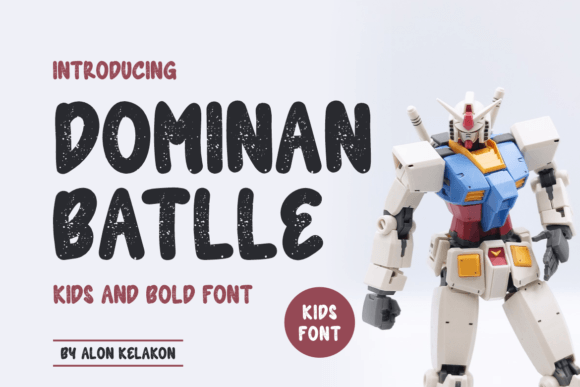
This is where a typeface like Dominan Battle Font enters the conversation. It’s crafted as a childish, easy-to-read display font that conveys impeccable friendliness. The letterforms are designed to be immediately legible, even at larger sizes typical of headlines and logos, while maintaining a cohesive, cheerful character. The strokes are consistent, avoiding overly thin or thick variations that can cause visual strain. This balance ensures that while the font has a strong, playful personality, it doesn’t sacrifice the clarity needed for effective communication. It’s a premium font that understands its role: to be the friendly face of your message.
Practical Applications Across Creative Fields
The true test of any creative font is its versatility. Can it move from a digital screen to a printed product without losing its charm? A typeface with a friendly disposition has a surprisingly wide range of applications. For small business owners and entrepreneurs, this font style can become a cornerstone of brand identity. Imagine a local bakery using it for its logo and packaging—the rounded, soft letters immediately suggest homemade goodness and approachability. A children’s clothing brand could use it on tags, website headers, and social media graphics to create a consistent, playful aesthetic that resonates with parents.
For content creators and marketers, the font offers a way to break through the noise of overly corporate or generic typography. It’s perfect for creating engaging social media graphics, especially for posts aimed at families, educators, or lifestyle audiences. Use it for the title slide of a presentation to set a welcoming tone, or for headers in a blog focused on crafts, parenting, or DIY projects. In editorial design, it can be used for pull quotes or section headers in magazines or digital publications to add visual interest and guide the reader’s eye with a friendly nudge. The applications extend to merchandise like t-shirts and mugs, invitation cards, posters for community events, and even user interface elements for apps or websites targeting a general audience.
Strengthening Brand Identity and Engagement
Typography is a silent ambassador for your brand. The fonts you choose communicate values and personality long before a customer reads a single word. Opting for a display font with a friendly, childish aesthetic makes a clear statement: your brand is approachable, trustworthy, and perhaps doesn’t take itself too seriously. This can be incredibly powerful for building emotional connections with your audience. When a customer sees a consistent typographic style across your website, your packaging, and your Instagram feed, it builds recognition and reinforces your brand’s unique voice. This visual consistency is a fundamental principle of effective brand identity.
Readability is another critical factor, and a well-designed friendly font excels here. Because the letterforms are open and rounded, they are less likely to be misinterpreted, which is crucial for everything from product names on a shelf to the call-to-action button on a website. This clarity reduces cognitive load for your audience, making your message easier to absorb. The result is often better engagement—people are more likely to stop scrolling to read a social media graphic set in a font that feels inviting, or to pick up a product whose label feels cheerful and clear. This isn’t just about aesthetics; it’s about practical communication that drives results.
Making Smart Typographic Choices
Integrating a new font into your toolkit requires some thoughtful consideration. First, always review the full character set and included styles. A quality font family will often include multiple weights or variations, which can provide flexibility for creating hierarchy within your designs—using a bolder style for headlines and a regular weight for subheadings, for example. Next, consider font pairing. A highly stylized display font like Dominan Battle works best when balanced with a more neutral companion. Pair it with a clean sans-serif font for body text on a website, or a simple serif for longer paragraphs in a brochure. This contrast allows the playful font to shine in its intended role without overwhelming the entire design.
Always test the font in context. Mock up your logo, your social media post, or your product label before finalizing. Check the readability at the actual size it will be used. Does it still feel friendly and clear when scaled down on a mobile screen? Does it maintain its character when printed on textured paper? Finally, pay close attention to the licensing. For any commercial project—whether you’re selling products, offering services, or creating client work—ensure you have the appropriate commercial license. This protects both you and the font designer and is a non-negotiable step in professional practice.
Finding a typeface that perfectly captures a sense of joyful simplicity can feel like uncovering a hidden gem. It’s a design asset that does more than just display words; it sets a mood, tells a story, and builds a bridge to your audience. When your project calls for a voice that is inherently kind, clear, and full of character, a font built on the principles of friendliness becomes an indispensable part of your creative process, turning ordinary layouts into memorable experiences.